The Bootcut Office Outfit for the First Genuinely Cold Week
Quick Answer: Cold-weather bootcut styling comes down to three decisions: a heel with enough height to keep the hem off wet ground, a fine-gauge knit or a tucked shirt to keep the volume balanced now that the trousers sit over a boot, and a long coat rather than a short jacket so the vertical line continues. The hem length that worked with a flat shoe in September is usually about an inch too short once you add a boot.
Most bootcut outfits fail in autumn at the ankle. Everything above the knee is fine; the hem and the shoe are where it goes wrong.

Why does the hem length change everything?
Because bootcut is defined by the relationship between the flare and the shoe, and a boot changes that relationship entirely.
The purpose of a bootcut is to widen slightly from the knee so the hem clears a shoe without breaking. With a flat shoe, the hem needs to finish roughly a centimetre above the floor at the back and just touch the top of the foot at the front. That is the length most people have their trousers altered to, usually in warmer weather with a flat.
Add a boot with even a low block heel and that same trouser is now short. The hem rides up, revealing the boot shaft, and the flare no longer has anything to flare over. The line breaks at the ankle and the whole silhouette shortens.
The practical solutions:
- Own two lengths, or have one pair hemmed for boots and one for flats. This is what people who wear bootcut year-round actually do.
- Buy long and cuff or hem seasonally if you are prepared to do the work.
- Match the heel height to the pair you have - if they were hemmed for a 5cm heel, wear a 5cm heel.
The rule to remember: the hem should cover the top of the boot shaft entirely. If the boot shaft is visible under a bootcut trouser, either the trouser is too short or the boot is too tall. A short ankle boot under a properly-hemmed bootcut disappears completely, which is exactly what you want.
What shoes actually work under bootcut in cold weather?
Fewer than you would hope, and the constraint is the width of the hem opening.
Best options:
- A pointed ankle boot with a block heel of 4 to 7cm. The heel keeps the hem clear of wet pavement, the block is stable for a commute, and the point extends the line. This is the single most reliable choice.
- A Chelsea boot with a modest heel. Clean, no hardware, and the elastic side panel keeps the shaft narrow enough to sit under the flare.
- A loafer with a stacked heel. Works in dry weather, but the hem gets wet on a bad day.
- A knee boot - but only with the trouser worn over it, which requires both a wide enough hem and a boot with no bulk at the calf.
What does not work:
- Anything with visible buckles or straps at the ankle. The hardware catches the hem and the outline reads as lumpy.
- A chunky lug sole. The proportion fights with the flare and adds width exactly where the trouser is already widening.
- A tall stiff boot shaft. It creates a ridge under the trouser and shortens the leg visually.
- Ballet flats in wet weather - the hem sits on the ground and wicks water for the rest of the day.
The wet-ground problem is genuine. A bootcut hem is wide and sits low, which makes it the most likely trouser shape in your wardrobe to arrive at the office with a wet six inches. A modest heel is not a style choice here so much as a practical one.
How should the top half change as it gets colder?
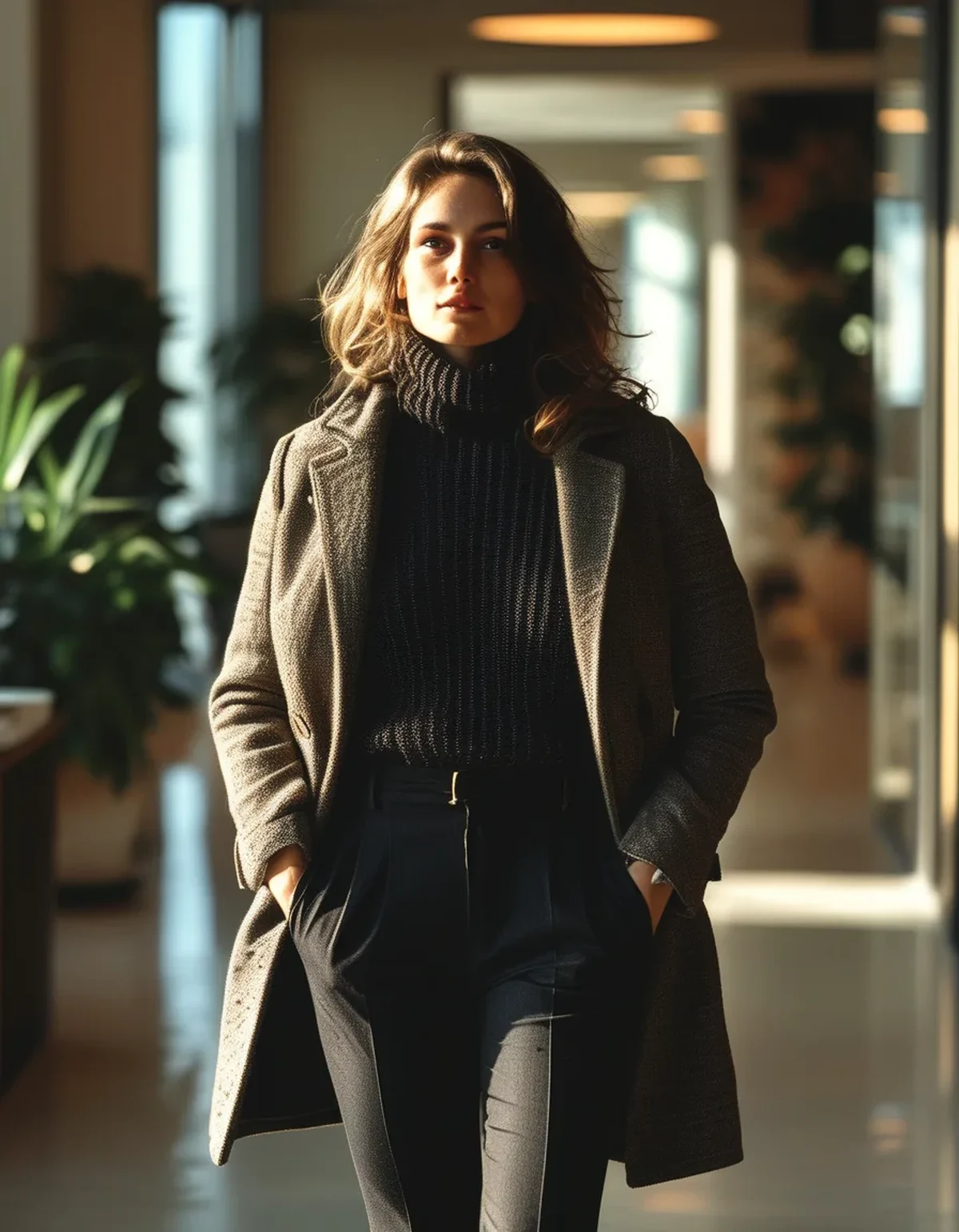
The trousers add visual volume at the bottom, so the top needs to stay controlled - which is harder once you are layering for warmth.
The reliable formula: fitted or semi-fitted on top, tucked or finishing at the hip, with any volume carried in an outer layer that hangs open.
What works:
- A fine-gauge knit, tucked or half-tucked. Merino, cashmere, or a fine wool blend. Warm without bulk, which is the whole problem solved in one garment.
- A silk or cotton shirt with a knit over the top, collar out. Two thin layers, more warmth than one thick one, no added volume.
- A fitted long-sleeve top with a blazer. The most straightforwardly office-appropriate option.
What causes problems:
- A chunky oversized jumper. Volume on top plus flare on the bottom leaves no defined line anywhere, and the silhouette reads as shapeless rather than relaxed.
- Anything finishing mid-thigh. It cuts the leg at its widest point and hides where the trouser starts to flare, which is the shape you are paying for.
- A cropped jacket that ends at the waist with a high-rise trouser can work, but it is a narrow target.
The tuck matters. Bootcut trousers are usually high or mid rise, and the shape depends on the eye being able to see where the waist is. An untucked top over a high-rise bootcut hides the rise and the leg reads shorter. A half-tuck at the front is the low-effort version.
Myth vs Fact: Bootcut for the Office
Myth: Bootcut is dated and skinny or wide-leg is the only current shape. Fact: Bootcut and flared shapes have returned firmly to mainstream ranges, and the office version - dark, matte, well-hemmed - has never really been out of place in professional wardrobes. It is one of the more forgiving shapes across body types, which is why it persists.
Myth: Performance-fabric bootcut is fine for the office if it is black. Fact: Colour is not what gives it away - sheen and drape are. A shiny four-way stretch fabric reads as activewear at any colour. A matte ponte, a heavy jersey, or a wool blend passes; a glossy technical knit does not.
Myth: You need a high heel to carry a bootcut. Fact: 4 to 5cm is plenty. The heel’s job is to keep the hem off the ground and set the hem length, not to add height. A low block heel is more practical and looks more considered than a stiletto with a wide hem.
Myth: The flare should be dramatic. Fact: For the office, a subtle flare from the knee reads as tailoring; a pronounced one reads as a fashion statement. The difference between a bootcut and a flare is precisely the difference between a work trouser and a going-out trouser.
Myth: Bootcut only suits tall people. Fact: The proportion depends far more on the hem length and rise than on height. A correctly hemmed bootcut with a modest heel and a high rise lengthens the leg, which is the opposite of the common assumption, and it is the point most people get wrong when they try the shape and conclude it does not suit them.
FAQ: Cold Weather Bootcut, Answered
How long should bootcut trousers be?
With the shoes you intend to wear, roughly one centimetre off the floor at the back and just brushing the top of the foot at the front. This is why hem length is shoe-specific.
Can I wear boots under bootcut trousers?
Ankle boots yes, always with the trouser over the shaft. Knee boots only if the hem is wide enough to pass over without pulling, which many are not.
What fabric works for a cold office?
Ponte, wool blend, heavy jersey, or a thick twill. All hold their shape, all read as tailoring, and all handle the temperature better than a thin technical knit.
How do I stop the hem getting wet?
A modest heel, plus checking the length while standing in the shoes rather than sitting. If your commute is genuinely wet, a slightly shorter dedicated pair for winter is a reasonable compromise.
Are bootcut trousers appropriate for a formal office?
In a matte tailoring fabric, dark colour, correct length, with a blazer - yes, in most professional environments. In performance fabric, no, regardless of styling.
TL;DR:
- Hem length is shoe-specific; a boot makes a flat-hemmed bootcut about an inch too short
- A 4 to 7cm block heel keeps the hem off wet ground and sets the line
- Fine-gauge knits and tucked shirts on top - volume above plus flare below has no shape
- Matte, heavy fabric is what separates office bootcut from activewear
- The hem should cover the boot shaft entirely; visible shaft means the length is wrong
Bootcut is one of the few trouser shapes that genuinely gets better in cold weather, because it works over a boot in a way skinny and wide-leg both struggle with. It just needs the hem taken seriously - which usually means owning one pair hemmed for flats and one for heels, and stopping there.
See It in Motion
Seen here: Bootcut Capri Yoga Pants with Pockets — shop similar styles on bubblelime.com
Keep Reading
This article is for general informational and styling purposes only. Fit, sizing, and product availability may vary.